


Before loading the trailer, always verify the weight of the cargo to prevent overloading.
Here you will find the necessary and useful information for trailer users. What type of driving licence is required to tow a trailer and what is the permitted trailer weight? What do the Road Traffic Regulations say? How should cargo be properly placed and secured on a trailer to ensure safe driving? How should a trailer be maintained and cared for to ensure long-term durability? What are the warranty terms for TIKI trailers?
Get the information you need and drive safely!
Instructional Videos
How to Ensure Your Trailer Is Ready for Driving
How to Use a Winch?
How to Use a Motorcycle Holder!
How to Balance the Load?
How to Remove the Plastic Cover?
How to Use the Plastic Cover?
TIKI CP300-350-LH PRO + Plastic Cover
TIKI BX750-LW Multi Roller PRO Boat Trailer
Trailer Operation
Pay special attention to the sections marked with an exclamation mark, as they are particularly important for your safety.
Retain this manual for future reference during the entire service life of the trailer. If you have any questions not covered in this manual, please contact our sales office or your authorized trailer dealer.
Loading Cargo onto the Trailer
High-density materials such as bricks, sand, etc. are extremely heavy even in small volumes, and it is easy to overload a trailer with them. An overloaded trailer may become unstable and difficult to control.
Please note! If the trailer is fitted with accessories (e.g. a plastic cover, additional side panels, a spare wheel, etc.), their weight must be included in the total load weight.
The weight of the cargo must not exceed the trailer’s load capacity!
Here’s how to find the trailer’s load capacity:
Load capacity = Gross weight – Unladen weight
Before driving with a load, make sure you do not exceed the maximum permissible actual mass of the trailer as specified by the towing vehicle manufacturer. This information is indicated in the vehicle’s registration certificate.
Cargo loading and placement
Load the trailer only when it is properly coupled to the tow hitch.
Ensure that the towing vehicle’s parking brake is engaged.
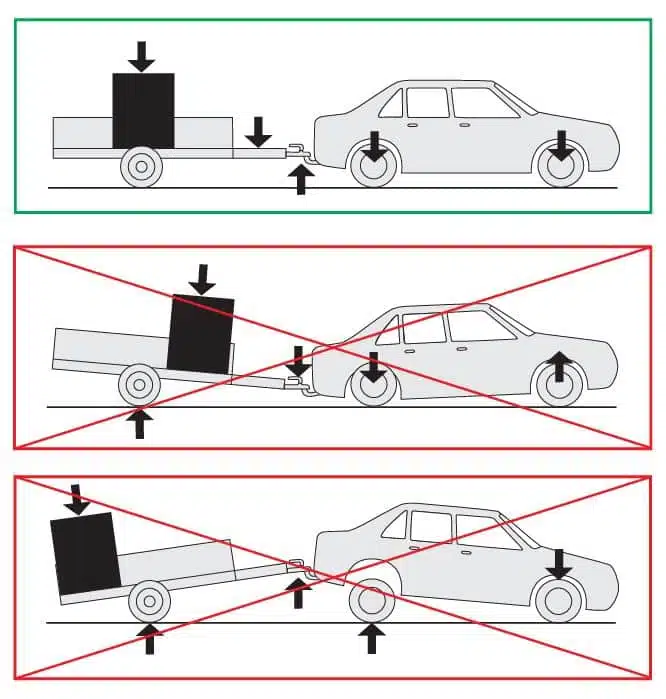
The load placed in the trailer must be properly secured to prevent movement during transport.
When transporting items, secure them to the trailer’s lashing points using load securing straps. Use straps with adequate strength according to the weight of the load. The strap capacity is indicated on the strap’s label. Use only straps with legible markings and without damage or knots.
For transporting loose materials (sand, gravel, etc.) that cannot be secured with straps, it is recommended to cover the load with a tarpaulin and drive at a reduced speed to prevent hazardous situations.
Before driving
Before the first use of the trailer, tighten the wheel bolts to 95 Nm. After the first trip, retighten them.
Before driving, always check the following:
-
The coupling head must be properly secured onto the tow ball, and the safety cable or breakaway cable (for braked trailers) must be attached.
-
All trailer lights must be functioning properly.
-
The trailer tyre pressure must be equal on both sides and between 80% and 100% of the maximum pressure indicated on the tyre.
-
The remaining tyre tread depth must comply with legal requirements.
-
The load must be securely fastened.
-
Hatches, additional side panels, and other accessories must be properly secured.
-
The jockey wheel must be raised to the upper position and secured in the travel direction.
-
The handbrake must be released (for braked trailers).
Trailer registration and driver licensing requirements
A trailer is a vehicle and must be registered with the CSDD, just like a car. Registration requires the trailer’s EC Certificate of Conformity and a purchase document. If you wish, we can handle the registration process on your behalf. For this purpose, we will need your details.
When registering a trailer with the CSDD, a state fee of EUR 34.59 and a natural resources tax of EUR 20.00 must be paid.
Key definitions
- Gross weight (maximum permissible mass) – The actual mass of the vehicle at a given moment, including the driver, passengers, and cargo. Indicated in the vehicle registration certificate.
- Unladen weight – (vilces vienības) un vienas vai vairākām piekabēm vai velkamas tehnikas;
- Autovilciena pilna masa – transportlīdzekļa(-u) un piekabes(-u) pilnas masas summa.
- Vieglā piekabe – piekabe, kuras pilna masa nepārsniedz 750 kg;
- Piekabe – pilna masa 751–3500 kg
Piekabju kategorijas
Piekabes tiek iedalītas šādās kategorijās, pamatojoties uz pilnu masu:
- O1: pilna masa nepārsniedz 750 kg (vieglā piekabe, bremzes nav obligātas)
- O2: pilna masa 750 kg–3500 kg (bremzes ir obligātas, galvenokārt inerces bremzes)
- O3: pilna masa 3500 kg–10 000 kg (nepārtrauktas bremzes)
- O4: pilna masa vairāk nekā 10 000 kg
Kāda ir piekabes pilna masa, kas atļauta autovilcienā?
Ceļu satiksmes likums to apraksta šādi:
§ 34. 11. punkts – Autovilciena vai mašīnvilciena piekabes pilna masa nedrīkst pārsniegt piekabes maksimālo masu, kas noteikta, reģistrējot vilcēju. § 2 84. punkts – Pilna masa ir transportlīdzekļa faktiskā masa konkrētajā brīdī kopā ar tā vadītāju, pasažieriem un kravu.
Kādas vadītāja apliecības ir nepieciešamas?
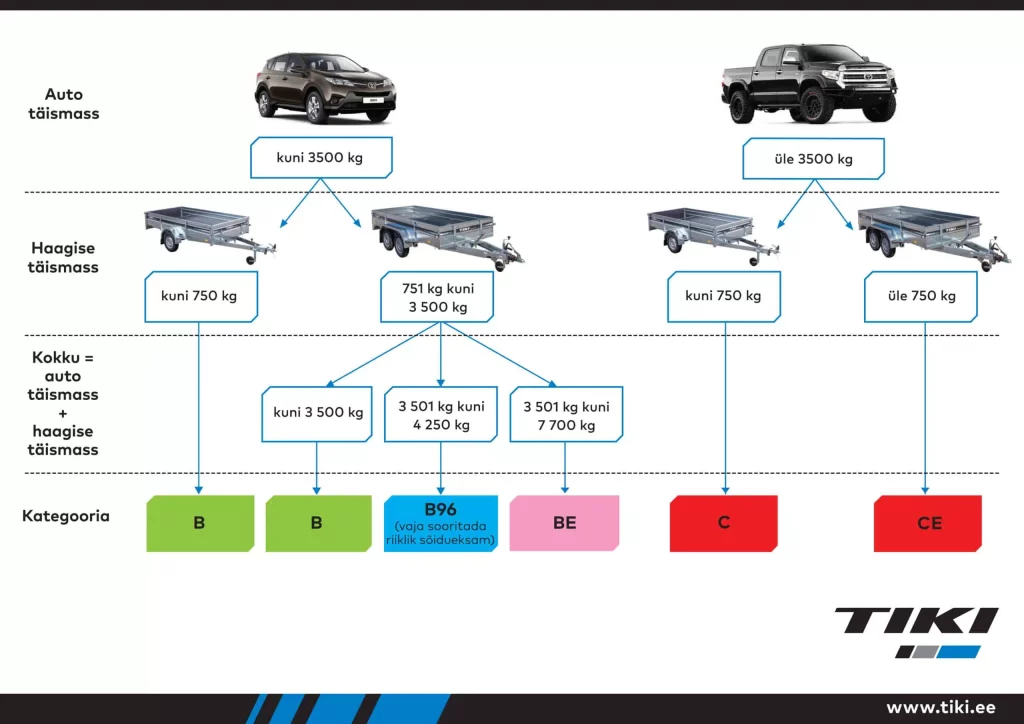
Pirms braukšanas ar piekabi pārliecinieties, ka jums kā vadītājam ir vadītāja apliecības kategorija, kas nepieciešama konkrēta transportlīdzekļu sastāva vadīšanai!
Vai jums ir B kategorijas vadītāja apliecība?
Ar B kategorijas vadītāja apliecību ir atļauts vadīt vieglo piekabi (līdz 750 kg). Izmantojot vieglo piekabi, nav nepieciešams uzraudzīt kilogramus attiecībā uz braukšanas tiesībām.
Piemērs: jums ir furgons ar pilnu masu 3500 kg un vieglā piekabe ar 750 kg masu. Lai gan kopējā pilna masa ir 4250 kg, jūs varat vadīt šo autovilcienu ar B kategorijas vadītāja apliecību.
Vai vēlaties vilkt piekabi ar pilnu masu 751 kg un vairāk?
Tagad jāsāk aprēķināt vieglās automašīnas un piekabes kilogramus. Ar B kategoriju jūs varat vadīt autovilcienu ar pilnu masu līdz 3500 kg.
Piemērs: jums ir transportlīdzeklis ar pilnu masu 1897 kg. Tas nozīmē, ka jūs varat vilkt piekabi līdz 1603 kg. Tas, protams, ir atļauts transportlīdzeklim.
B96 – piezīme vadītāja apliecībā
Ja vēlaties vilkt lielāku piekabi (pilna masa virs 3500 kg, bet zem 4250 kg), bet vēl nevēlaties apgūt BE kategoriju, ir arī starpposma variants. B96, t. i., B kategorijas autovadītāja apliecība ar 96. piezīmi. Ar šāda veida apliecību var vadīt autovilcienu ar piekabi, kas nav vieglā piekabe, un transportlīdzekļa un piekabes kopējais svars ir līdz 4250 kg. Lai iegūtu B96 kategoriju, jānokārto braukšanas eksāmens Transporta administrācijā.
BE kategorijas autovadītāja apliecība
Tomēr, ja nepieciešams vilkt vēl lielāku piekabi, vadīšanai jau ir jābūt BE kategorijas autovadītāja apliecībai. Lai to izdarītu, jāapgūst BE kategorija autoskolā un jānokārto gan teorijas, gan braukšanas eksāmens Transporta administrācijā.
Ar BE kategorijas autovadītāja apliecību var vadīt B kategorijas vieglo automašīnu (pilna masa līdz 3500 kg) un piekabi ar pilnu masu līdz 3500 kg, ja automašīnai ir atļauts pārvadāt šādu piekabi.
Riepas
Visas Tiki piekabes ir aprīkotas ar M+S riepām un lietojamas ziemas un vasaras sezonā.
Maksimāli pieļaujamais riepu spiediens ir norādīts uz riepām. Piekabes riepu un disku izmēriem un slodzes indeksam jāatbilst piekabes ražotāja norādītajiem parametriem, kas norādīti reģistrācijas apliecībā. Vasaras riepu protektora dziļumam jābūt min. 1,6 mm, ziemas riepām min. 3,0 mm.